
Case Study
Trellis: feedback for yoga teachers, after the training ends
Yoga teachers get detailed feedback during training and then almost none for the rest of their careers. Trellis is the app I designed and built to close that gap: record a class, get specific feedback grounded in what you actually said, and see how your teaching changes from one class to the next.
- Organization
- Trellis, my own product
- Timeframe
- July 2026 – present
- Role
- Founder: discovery, product design, the AI coach, and the build
31
Classes coached
Across five teachers since July 2026: my own classes and four colleagues'.
6
Rubric dimensions
Cueing, language, sequencing, pacing, presence and theme, each point backed by a quoted line.
3
Platforms
Web, iOS and Android from one codebase, with native recording that keeps going on a locked screen.
My role
- ·Ran discovery on my own teaching, with colleagues, and with the owner of a studio that runs teacher trainings.
- ·Designed the product, the coaching rubric and the rules the AI coach follows.
- ·Built it end to end with AI coding tools: native recording, the processing pipeline and the app, in English and Spanish.
- ·Designed the experiment that tests whether the feedback changes how teachers teach.
01 / The challenge
A 200-hour yoga certificate is a driver's license. It lets you teach, and most of the getting good happens afterwards, on the job. Yet for most teachers, real feedback stops when training ends.
The feedback chain breaks at every link. Right after class, a teacher is frazzled, packing up and not ready to hear it. Someone has to have paid close attention for a whole hour to give it. It's rarely written down or shared, and nothing tracks it over time, so nobody can see whether a teacher is growing.
I teach every week, and I wanted a mentor that listens to every class, for myself and for the teachers around me.
02 / Approach
Discovery
Starting from the whole feedback chain
I started with my own classes and the teachers I work with, then a discovery call with the owner of a studio that runs teacher trainings. Willing mentors weren't the problem. The chain was: someone paying attention, at a moment the teacher can take it in, written down, shared, and tracked. The product had to carry all of it without asking a tired teacher to do more after class.
The coach
Writing the rules the AI coach follows
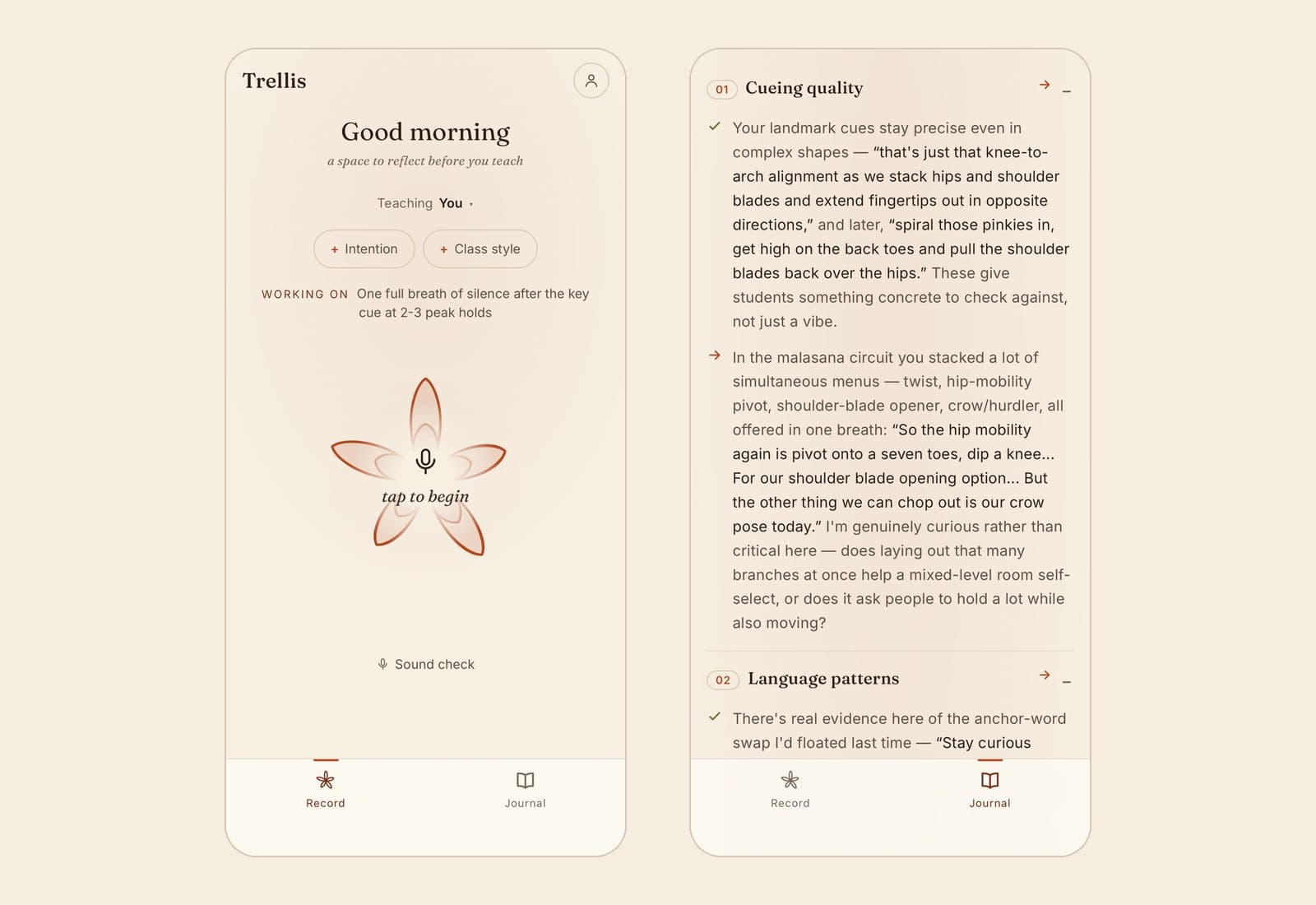
The coach follows a written specification. Every point is backed by a line quoted from the class. Each class is judged by the norms of its own style. And the coach leads with what worked, at length, because confidence is what decides whether new teachers keep teaching.
- ·Curiosity before judgment. A repeated phrase is often a deliberate anchor. The coach counts it and asks about intent, and only flags a refrain once it has drifted from what it says: "one more breath" followed by several more.
- ·Measured, not guessed. The coach can't hear silence in a transcript, so it judges pacing only from measured numbers: pace, voice share and pauses.
- ·No false credit. It may never say a teacher tried one of its earlier suggestions unless the transcript shows it. False credit erodes trust as fast as harsh criticism does.
Reliability
Refusing to coach on what it can't hear
A faint or noisy recording produces a thin transcript, and a confident readout built on bad audio would do real harm. Trellis checks the capture first and says so plainly instead of guessing. One unreadable segment doesn't sink a whole class, retries are safe, failures send an alert, and stranded classes can be recovered.
The loop
Turning one readout into the next class
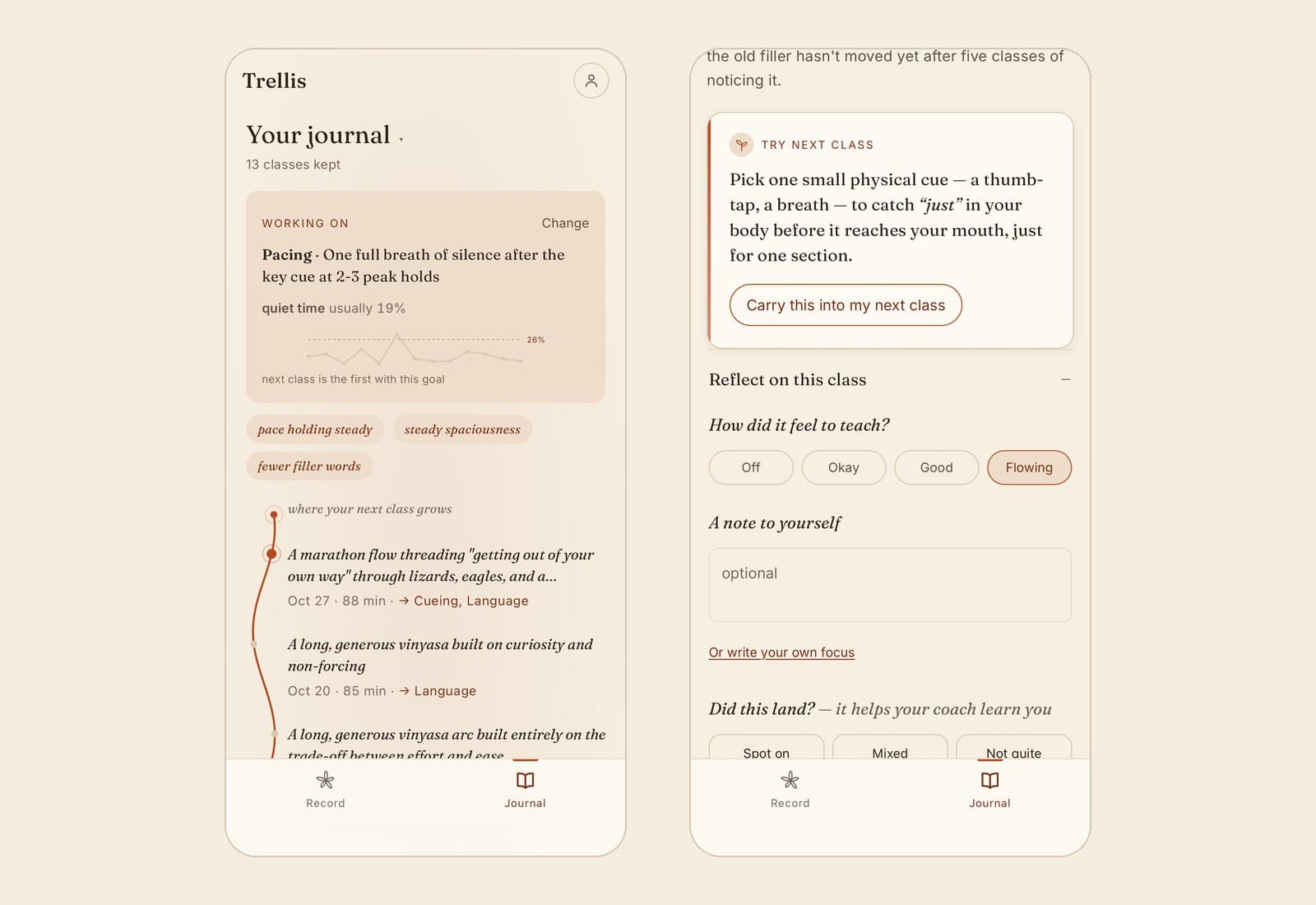
The coach remembers its last three readouts for each teacher, their standing goal and their own reactions. It won't repeat a suggestion, and when the same pattern shows up three classes running, it says so and offers it as a goal. A "Try next class" suggestion can be carried into the next class, where it waits on the record screen and is checked in the next readout.
The build
One product on three platforms
Native recording on iOS and Android keeps going with the screen locked and uploads during class, so a long class is never one fragile file. There's an offline queue, push notifications, English and Spanish, and updates that ship without a new app store release. Audio is deleted once it's been processed, and classes are never played back.
I built it with AI coding tools. The decisions were mine: what to build, how the coach behaves, and what counts as evidence.
Measuring
Testing whether it changes teaching
Readouts only matter if teaching changes. The first experiment started in October 2026 on one goal, a full breath of silence after the key cue at peak holds, with a ten-class baseline, a success threshold set in advance and a fixed window. I'll report the result here, whichever way it goes.
03 / Outcomes
A working product, used every week
Live on the web, with native builds for iOS and Android. 31 classes coached across five teachers since July 2026.
A pilot with a yoga teacher training program
Being discussed. The program stays unnamed until it runs.
The open questions, stated plainly
No teacher has yet reported that the feedback changed how they teach, and I don't claim it; the first experiment reports in late November 2026. Consent when students are heard on a recording is still an open design question.
04 / What it taught me
- ·Trellis is where I practice what I sell: start from the problem, make small bets, and get evidence before making claims.
- ·Frontier technology is most useful pointed at an old, unglamorous gap. Feedback for teachers is a human problem first; AI made it solvable.
- ·An AI product's quality lives in its rules: what the model may claim, what it must measure instead of guess, and when it should decline to answer.
That was Trellis.Let's talk about your company.